Boizel in Épernay: One Family, Partner Growers, a Cellar Geared to Freshness
Six Generations at 46 Avenue de Champagne
Founded in 1834 by Auguste Boizel, the house has always been headquartered on the Avenue de Champagne in Épernay, one of the two capitals of Champagne, along with Reims. Passed down in a direct line, it has been run since 2018 by Florent and Lionel Roques-Boizel, the sixth generation, who also craft the blends as cellar masters [TO BE VALIDATED: 2018 according to The Drinks Business, 2019 according to Gault&Millau].
In 1994, the Boizel family sold a majority of its capital in exchange for a stake in the group that has since become Lanson-BCC, the B of which stands for Boizel. The management of the house has remained in family hands. In 2024, Boizel produced around 500,000 bottles a year, half of them sold in France.
Seven Hectares of Its Own, Eighty with Partner Growers
Maison Boizel owns 7 hectares in the Côte des Blancs and the Marne Valley. Most of its grapes come from partner growers, across roughly 80 hectares within a 30-kilometre radius of Épernay. Each grape variety has its own area: Chardonnay comes from the Côte des Blancs, Pinot Noir from the Montagne de Reims, and Meunier from the Marne Valley.
Florent Roques-Boizel personally oversees these relationships with growers, many of which have been established over several generations. In his view, access to the best grapes is now more fiercely contested than export markets.
A Cellar Renovated for Tension
Boizel's winery, renovated for the 2017 harvest, was fitted with small stainless steel tanks, barrels and foudres. Why renovate if the style is not changing? To preserve the freshness and tension of the wines as the climate warms, the house explains.
At Boizel, only the first juices from pressing are kept, and all the wines undergo malolactic fermentation. Dosages have come down: in 2024, no cuvée exceeded 7 g/l, and most were extra bruts dosed at 3 to 5 g/l.
The house's chalk cellars, at 11°C, slow the secondary fermentation, and all the wines remain there for at least three years on lees. "Great terroirs need time to express themselves," sums up Florent Roques-Boizel.
Choosing a Boizel Champagne: Non-Vintage, Origin Cuvées, Single-Village Cuvées and Vintages
Three Non-Vintage Cuvées to Enter the Range
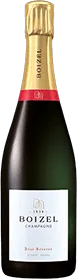
Boizel's three non-vintage cuvées make up the entry price tier, and the pursuit of freshness can already be tasted in them. The Brut Réserve is the house's reference brut, dominated by Pinot Noir; 5% of its wines are aged in foudre, for roundness of texture rather than for any taste of wood. The Rosé Absolu is a blended rosé, coloured with red wine from Les Riceys, in the south of Champagne, with the same share of foudre.
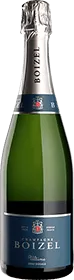
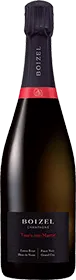
Boizel's Ultime Zéro Dosage, created in 2008, is a brut nature: no liqueur is added after disgorgement. Made from half Pinot Noir, completed with Chardonnay and a little Meunier, it rests on lees for at least five years, which gives it its creamy mousse and a balance that no sugar needs to correct.
La Côte and La Montagne: Names That Point to an Origin
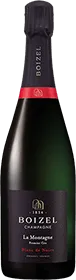
The La Côte and La Montagne cuvées are the house's former blanc de blancs and blanc de noirs, renamed to tell where they come from. La Côte Blanc de Blancs Premier Cru is a pure Chardonnay from the Côte des Blancs, drawn mainly from Chouilly, Le Mesnil-sur-Oger, Avize and Vertus. La Montagne Blanc de Noirs is a pure Pinot Noir from Cumières, Mailly and Chigny-les-Roses.
Both cuvées remain blends of several villages, as Boizel considers blending to be the heart of the Champagne craft. La Côte appeals to the lover of fine, chalky blanc de blancs, La Montagne to those seeking the ripe fruit and brioche of Pinot Noir.
Avize or Tours-sur-Marne: The Single-Village Cuvées
Boizel's single-village cuvées take the opposite approach: one village, one grape variety. Launched in 2025, the collection was joined in 2026 by two Grand Cru wines from the 2020 vintage, both aged five years on lees.
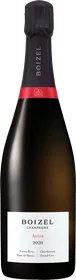
Avize Blanc de Blancs Grand Cru comes from a village where the family has part of its roots and still farms several plots. Tours-sur-Marne Blanc de Noirs Grand Cru lies at the junction of the Montagne de Reims and the Marne Valley, on clay-limestone soils rich in chalk. Avize is built on chalk and salinity, Tours-sur-Marne on the generosity of Pinot Noir, between cherry and redcurrant.
Grand Vintage and Joyau: The Two Vintage Cuvées
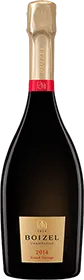
Grand Vintage and Joyau form the top tier of the Boizel range. Grand Vintage is the house's vintage extra brut, a blend of Pinot Noir and Chardonnay; the 2015 spent eight years on lees. Joyau has been the flagship cuvée since 1961, and was called Joyau de France up to the 2008 vintage, the first bottles of which still carry the old name.
Joyau comes exclusively from grands and premiers crus: for the 2013, Mailly, Chigny-les-Roses and Aÿ for Pinot Noir, Avize, Oger and Cuis for Chardonnay. Around 10% of the blend is vinified in old barrels, and the wine spends more than ten years on lees before a minimal dosage (3 g/l for the 2008). Since March 2023, Boizel has also entrusted its international distribution to négociants of the Bordeaux market.
Cellaring and Serving Boizel Vintage Champagnes: Vertical, Disgorgement, Glass
Joyau, a Cuvée to Compare from One Vintage to the Next
Its time in the cellar makes Joyau a cuvée to follow in a vertical tasting, with each vintage bearing the mark of its year and its time on lees. The 2008, which spent twelve years on lees, has taken on a pastry-like profile that makes it a wine for the table. The 2012, aged ten years, retains a livelier palate.
The Disgorgement Date on the Back Label
Boizel's vintage champagnes carry the disgorgement date and details of their production on the back. For a wine that has stayed so long on lees, this information matters: it shows how long the wine has been evolving without its yeasts, and distinguishes a freshly disgorged bottle from one that has already acquired some patina.
Grand Vintage and Joyau are served chilled but not ice-cold, in a tulip glass rather than a flute. This gives the bouquet of dried fruit and toasted bread room to open up.