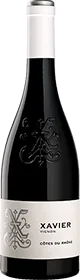
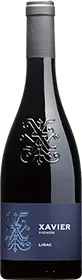
Xavier Vignon: an oenologist-blender, négociant-éleveur and vineyard owner
From laboratory to signature cuvées
Xavier Vignon is a consulting oenologist who arrived in the southern Rhône Valley in 1996 and has made his own wines since 1998, without ever ceasing to advise other estates. In 2003, the Institut œnologique de Champagne entrusted him with a laboratory whose historic clientele was based in Châteauneuf-du-Pape, and his team went on to support up to 450 estates. His first wines were not intended for sale: they were small lots drawn from the crus he was working with, to show what the southern Rhône was capable of. Their appearance in the Guide Hachette 2000 brought buyers to his door: he registered as a négociant, and Xavier Vins was born.
Partly négociant, partly estate-owned
Xavier Vignon is not an estate in the classic sense. Part of his wines comes from vats selected from winegrowers whose plots he knows well, the rest from his own vines, acquired after the sale of his laboratory in 2012.
A blender trained in Champagne
While studying oenology in Montpellier, Xavier Vignon completed 13 harvests in seven years across both hemispheres, and learned the art of blending at Moët & Chandon under Dominique Foulon and Richard Geoffroy. This training explains his range. Just as a non-vintage brut draws on its reserve wines, several of his cuvées bring together different vintages, in a region where the vintage usually appears on the label. His rule, as he puts it: “You must first live by and within the rules in order to learn to break free from them methodically.”
The Dentelles de Montmirail, a reservoir of soils
The Dentelles de Montmirail massif owes its diversity to a movement of the Nîmes fault, which brought to the surface soils of widely differing ages: Tertiary sands and sandstones, Jurassic and Cretaceous limestones and marls. Across this mosaic, the house says it follows around a thousand plots. It finds the raw material for its blends there.
Choosing a Xavier Vignon wine: Rhône crus, Châteauneuf-du-Pape, Arcanes or old vintages
Côtes du Rhône and Vaucluse crus, an introduction to the range
The appellation wines come from plots in the Dentelles and their surroundings, wines that express a cru rather than a blender's vision. The Côtes du Rhône, from limestone slopes and four grape varieties, is the entry point to the range. Above it, the Terroirs collection presents the crus: red Beaumes de Venise from high-altitude vines, Cairanne, Lirac and Rasteau.
The Vacqueyras comes from rolled pebbles. The Gigondas, from century-old vines at the foot of the Dentelles, is the highest-altitude cru of this family in the selection.
Châteauneuf-du-Pape, from the classic cru to vintage blends
Xavier Vignon interprets Châteauneuf-du-Pape in four ways. The Châteauneuf-du-Pape from the Terroirs collection offers the most direct reading of it. The Cuvée Anonyme brings together plots spread across all the terroirs of the appellation; some vintages are aged in amphora, and it also exists in white.
La Réserve is a non-vintage Châteauneuf-du-Pape that blends three years, each aged separately (concrete vat, demi-muid or oak barrel) before being united. Almutia Clair-Obscur, finally, is a white Châteauneuf-du-Pape vinified from black grapes.
How to read the name of a Réserve: the Roman numerals indicate the vintages blended. La Réserve XVI XIX XX combines 2016, 2019 and 2020; La Réserve X XII XV, 2010, 2012 and 2015.
The Arcanes, cuvées released only once
The Arcane collection brings together cuvées produced only once, then replaced by others, each dedicated to a vintage, a grape variety or a terroir. Their labels feature the cards of the Visconti-Sforza tarot, painted in 15th-century Italy. The appellation changes from one Arcane to the next: Arcane IX L’Hermite 2016 is a Gigondas, Arcane II La Papesse 2016 a Châteauneuf-du-Pape, Arcane XIV La Tempérance a Cairanne, Arcane L’Étoile a Beaumes-de-Venise.
Arcane VI Les Amoureux 2016 blends five crus: Lirac, Gigondas, Beaumes-de-Venise, Vacqueyras and Rasteau. For enthusiasts who enjoy comparing, it is the most freewheeling part of the range; for the cellar, these are bottles that will not return.
SM, north and south in a single wine
SM is a Côtes-du-Rhône from the Originale collection that blends wines from the northern and southern parts of the valley, hence its two letters. It also plays on vintages, which is why it is numbered by editions (SM 2nd Édition, SM 4th Édition) rather than by years. Unlike the Arcanes, these creations continue from one edition to the next.
Back Vintage, older vintages at maturity
The Back Vintage series offers Châteauneuf-du-Pape and Cornas wines from the 1990s and 2000s, ready to be opened.
A Muscat to end the meal
The Muscat de Beaumes-de-Venise is the range's vin doux naturel. Its tasting note describes it as centred on white peach and honeysuckle, with a freshness that sets it apart from heavier Muscats.
Vinarium, Wine Globe, mineral salts: how Xavier Vignon ages his wines
The Vinarium, barrels immersed in wine
Beyond blending, Xavier Vignon's signature lies in ageing, and first of all in the Vinarium, a 7,000-litre vessel in wood and stainless steel developed by the house. Five 200-litre barrels are immersed in wine inside it: the wine they contain ages at 100% humidity, with no oxygen or outside influence. The idea comes from bottles recovered after decades under the sea, which had remained remarkably fresh; the barrel hoops are made of stainless steel so that they do not rust.
The Vinarium “gives time to time, with no need to fight oxidation”, according to Xavier Vignon. In the selection, some tasting notes mention two years of ageing in this vessel.
Glass, so that nothing is added to the fruit
The Wine Globe, a 200-litre glass vessel, serves the same idea: ageing without the container leaving its mark on the wine. Arcane XIV La Tempérance, a Cairanne of 90% Grenache and 10% Syrah blending four vintages, from 2015 to 2018, was partly vinified and aged in it. Glass contributes neither wood tannins nor oxygen exchange, so the fruit remains in the foreground.
From mineral salts to a saline finish
Xavier Vignon links minerality, a word with no accepted definition, to a precise mechanism: the mineral salts that the vine draws from the water flowing through its terroir. As a young oenologist in Bordeaux, he observed the effect of minute quantities of salt on the structure of tannins; his research then led him to favour deep rooting, with the sun and wind concentrating these salts in the berry. He sometimes selects plots on this criterion alone: Arcane XV Le Diable 2015 blends very old Mourvèdre vines, some of them centenarian, from 17 plots in the Vaucluse chosen for their mineral salt content. In the Millésima selection, the saline finish recurs from one tasting note to the next, from the Côtes du Rhône to the Cuvée Anonyme.