Assistant



 Guaranteed provenanceDirect from the estates
 DeliveryFree Home delivery for orders exceeding € 300
 Secure PaymentVisa, American Express, Mastercard...
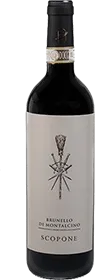
Scopone : Brunello di Montalcino 2021
Only 2 available
In-Stock
Let's talk about this product!
A pairing in mind? A question about the vintage? Comparison with another product? Find the answers here...
Description
Characteristics and tasting advice for Scopone’s Brunello di Montalcino 2021
Tasting
Color
The color reveals an intense ruby-red hue with a narrow orange rim.
Nose
The nose reveals aromas of black cherries and slate-like minerality. Notes of blueberries and blackberries are accompanied by dried Mediterranean herbs and a touch of bark. The bouquet evolves toward fragrances of black plums, blackberries, warm asphalt and orange blossom.
Palate
On the palate, the wine shows a medium body with juicy, savory tannins. The tannic structure is elegant and delicate, perfectly polished, leading to a supple and graceful finish. The whole displays remarkable sensory tension and a noble expression.
Food and wine pairings
This Brunello di Montalcino pairs ideally with meats in sauce and slow-cooked dishes. It matches beautifully with game such as wild boar, guinea fowl or duck. Traditional Tuscan dishes such as wild boar ragù find in it a companion of choice. It also pairs well with herb-roasted veal and pork, Chianina beef tartare with San Miniato white truffle, as well as pasta dishes such as tortelli with wild boar ragù or pappardelle. For cheese, opt for a barrel-aged pecorino di Pienza.
Serving and cellaring
This Brunello di Montalcino 2021 can be enjoyed now but will reach its peak between around 2026 and 2028. It has aging potential through the 2030s and beyond.
An elegant, mineral Brunello di Montalcino from southeastern Tuscany
The estate
Scopone traces its origins back to the 19th century as a Tuscan farm. The Genazzani family, of Dutch-Italian origin, acquired the forty-hectare property in 1992. On the advice of the legendary oenologist Giacomo Tachis in 1996, the family planted its first vines and released its first vintage in 1997. Since 2021, Cristina Minari has led the estate with the ambition of making it a benchmark of excellence in Montalcino. The name Scopone comes from the Erica scoparia shrubs that grow in the surrounding woods. Today, the estate spans twelve hectares of vines.
The vineyard
The vineyard of Scopone’s Brunello di Montalcino lies in the heart of Val d'Orcia, a UNESCO World Heritage Site, between Montalcino and Sant'Antimo in the province of Siena. The plots are planted at around 500 meters above sea level on 6 to 10% slopes facing southeast, toward Mount Amiata. The soils, rich in skeletal structure, come from the breakdown of galestro and alberese rocks, with a strong presence of limestone, clay and sandstone. The Vignone parcel, the main source of grapes for this Brunello di Montalcino, features deep soils with a medium gravelly texture and very high limestone content. Planting density reaches 5,210 to 5,680 vines per hectare.
The vintage
The 2021 vintage began with a long, cold winter with abundant snowfall and rain, replenishing water reserves. A milder, drier spring encouraged even budbreak, while cool breezes protected the vines from frost. Summer was marked by consistently moderate temperatures, despite a few peaks exceeding 38°C in August. The second half of July and early August brought the heat needed to trigger veraison. The summer drought, the second most severe of the past thirty years with only 99 millimeters of cumulative rainfall, concentrated the fruit’s characteristics. Late September and October offered ideal conditions with sunny, warm days and significant nighttime temperature swings. Yields fell by 15 to 20% across the appellation, naturally concentrating aromas. The 2021 vintage ranks among the five best years of the past two decades in Tuscany.
Vinification and aging
After hand-harvesting, the Brunello di Montalcino 2021 grapes are sorted by hand. Fermentation takes place in stainless steel tanks for seven to ten days at a controlled temperature between 28 and 29°C. A post-fermentation maceration of ten to fifteen days follows, with pump-overs in open and closed tanks during the first phases of fermentation. Aging takes place in French oak barrels of varying capacities, from 25 to 65 hectoliters, combining new barrels and one-wine barrels. Time in glazed cement tanks and bottle aging precede release.
Grape variety
Sangiovese (100%)