René Gabriel
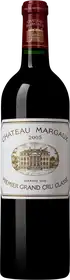
Paul Pontallier: <div style="font-style:italic;color:#990033">Since 1893 and 1989, this is the earliest harvest in our traceable history. It is the most concentrated vintage I have personally experienced at Margaux, thus denser than 1986 and 2000! However, 2003 will not go down as the year of drought, since 1995 was climatically even drier. It is the heat that characterizes the vintage in terms of tannins. And yet it has remained a classic, because despite the heat, there are no inappropriate, exotic notes in the aromatics of the youngest Château Margaux.</div> Barrel sample in 2004: 83% Cabernet Sauvignon, 12% Merlot, 5% Petit Verdot and Cabernet Franc. The yield was less than 30 hl/ha, and for the Petit Verdots in part as low as just 5 hl/ha. Only 45% of the harvest was selected as Grand Vin, which resulted in 150,000 bottles (about half the quantity compared to 1982 and 1983): Deep, dense purple with a violet sheen. Plenty of Cabernet expression on the nose, still cool and extremely profound, delicately floral yet refreshing notes, smoky contours, meaty, black peppercorns, and only afterwards do the blue and especially black-berried fruit notes emerge. On the palate, firm, meaty, a generous extract that still seems slightly angular; the massive tannin load prevents the finesse usually expected from Margaux and gives the wine an affinity more akin to a St. Estèphe. The power and potential are immense, but one must hope that further barrel ageing and the fat gained from the wood will bring more fullness and charm to this Premier Grand Cru with its rather rustic contours. Certainly no youthful charmer, and perhaps a Château Margaux that will partly have tannin configurations like 1981, 1986 and 1988. Perhaps it is precisely the overly intense concentration that prevents this wine from achieving true greatness. Looking at the tannins alone, old-wine aficionados are reminded of 1928, 1945 and 1961. Now this Margaux must prove over the next ten, perhaps even twenty years that it digests, i.e. integrates, these tannins, and whether it can truly belong to the greatest Médocs of the 2003 vintage. Other competitors like Giscours and Palmer currently seem to stand above this still questionable Margaux. Let’s wait and see! (18/20 2015 – 2040). In October 2004, when I knocked on Margaux’s door with a group from the Académie du Vin, I asked Paul Pontallier to let me taste the 2003 Margaux again. Rarely had a young wine from a Premier occupied me personally to such an extent. I tasted it after the “thin” 2001 and thus it appeared even more concentrated. Hot bouquet with scents of currants, lots of tar notes (almost asphalt contours…), dry and insanely concentrated. On the palate, robust, grainy, intense, indeed dominating tannin contour, massive build, for here the gripping muscles come into play in addition to the tannins. The potential is significantly higher than its class. (18/20). Still 5 months to go before bottling. Lightening garnet with a ruby rim. A crazy, delicate bouquet with lots of dried fruits, rumtopf, sultanas and vanilla sweetness, Parisette bread-crust tone and freshly cooked plum jam; despite the heavy sweetness, the wine seems fresh and almost playful on the nose. On the palate, full, creamy and opulent on the outside, with supportive muscles underneath that come more from the tannins than the acidity; dried bananas, exotic woods; in the finish, a certain tannin surplus relative to the wine’s own fat. An undeniably erotic wine with plenty of sweetness potential, reminiscent of ’61 in terms of tannins and ’59 in terms of fruit intensity. Only in 10 years will one know exactly which direction this powerful Margaux will take. 06: Crazy, hot bouquet, lots of dried fruit, first herbal notes; despite the enormous heat in the grapes, the wine somehow remains red-berried, very multi-layered with a hint of dryness. On the palate like a Richebourg and Chambertin at once, lots of firm tannins showing a certain hardness, hence an astringent texture; much astringency, concentrated and at the same time peppery, piquant acidity, still unruly and young. Yet the tannins point a far more positive way than I initially thought. Patience is the best way to experience this wine in its full greatness. (19/20). 08: Lightening purple-ruby. Open bouquet, cooked plums, glutamate notes, erotically sweet with hot fruit. On the palate, a phenomenal concentration inside, the outside currently wrapped in a fairly soft shell; in the aftertaste, however, you can feel the grippy, still very demanding tannins, jasmine tea and currants on the finish. The potential (19/20) is to be rated higher than the current enjoyment. (18/20). Potential rating sits at 19/20. 09: After almost 100 Tuscan wines in 5 days, Henri Prosperi www.ristorantehenri.com in Viareggio pulled this wine from his private cellar and served it blind. It was Bordeaux! It was like coming home! It was simply awesome. Soft and already rounding off quite well, which may also be due to the 2003 vintage. (19/20). 15: Extremely youthful color, lots of purple with violet highlights. While Haut-Brion and Mouton clearly indicated the hot vintage, the bouquet of the Margaux is full of freshly picked berries, cassis, raspberries and wild cherries. The nose thus shows dramatic fruit concentration. It continues on the palate with an equally dramatically concentrated, extremely dense extract; the massive yet fine tannins form a regal astringency and the wine ends as it began: almost over-fruited. Here one finds very clear parallels to its own 1983. And that sits at 20 points. And this Margaux 2003 will very likely move there as well. (19/20). 16: Deep purple, dense core, only slightly lightening at the rim. Powerful nose, meaty traces (glutamate), indicating wild Cabernet, licorice. After a few minutes, increasingly mineral. On the palate, thick, rich, almost bombastic, lots of sweetness and coming across like an almost winey Margaux liqueur; in the finish, dried figs and a hint of Vintage Port. In terms of taste, it lies far outside Bordeaux classicism. (19/20). 21: Deep, impenetrable purple. Begins with a brilliant parade of fruit: candied raspberries, grenadine, blackcurrant jelly, wax, vanilla, white smoke, precise, full and at the moment relatively communicative. On the palate, it seems significantly sweeter than on the nose and shows, besides its heft, a certain Pinot affinity, or trace elements that can be found in a wine from Priorat. The extract seems candy-like, but already quite charming. An atypical Château Margaux due to the hot vintage, to which one can certainly ascribe a certain pinch of eroticism. I would also call it a “soft drug.” (19/20).





 Guaranteed provenanceDirect from the estates
 DeliveryFree Home delivery for orders exceeding € 300
 Secure PaymentVisa, American Express, Mastercard...